2026 Winter/Spring Island Teacher List

Vancouver Island Dance Teachers 

Nanaimo

Lynette

www.lynetteharper.ca      dancetarab@gmail.com   250-797-7953   

LET’S DANCE    With apologies – My weekly multilevel classes are postponed until later in the year. All classes at VIBE Studios, Nanaimo 

*

Pynksy Shell aka Tania Amaral

https://www.facebook.com/tania.amaral.1253/  pynksyshell@gmail.com 

Afro Fusion Sharqi Danceᵀᴹ

Fridays 6:30 Level 1, VIBE dance studio 

www.afro-fusionsharqidance.ca 

*

Ramona 

ramona.passarello@gmail.com  250-616-3824  

Available for private individual and private group lessons.

*

Taissia 

778-269-0922  Dance and Wellness classes   Available for privates and workshops.

*

*

Other Island communities, listed alphabetically:

*

Cortes Island

Meinsje      250-895-1052  

*

Courtenay/Comox/Cumberland/Denman Island/Union Bay

Bridget Salas  bridgetsalasdance.com 

Beginner Indian fusion Tuesdays 5:45-7:00

Datura-style bellydance Tuesdays 7:15-8:30

Datura-style Zills Tuesdays 7:15-8:30

Magnoliamovementarts.com

*

Cathy Stoyko   Call or message (250)218-0704

Available for private classes on Denman Island or in Cumberland 

*

Emily Johnston – Forbidden Dance Company  

https://forbiddendancecompany.com  778-246-3639 

Belly dance levels 1-4 Thursdays 6:30-7:30pm Cloud 9 studio, Courtenay

“So you think you can belly dance?” Levels 5+  7:30-8:30pm

*

Heather Hilberry 250-898-3123 (call or text) 

Teaching on Hornby,  Denman and in Union Bay  

*

Linda Doerksen  halima.dancer@gmail.com    250-703-0494   

Contact regarding future classes in Courtenay. 

*

*

Duncan/Cowichan Area

Darlene Gunkelmann gunkelmanndarlene@gmail.com

12 week Duncan series starting Feb.16

Beginners Foundations 5 -6:15 pm, Multi-Level 6:15-7:15 pm

Studio B (behind Spinning Ninny). 

*

Karensa Camplair   saidisistersstudio.godaddysites.com  karensabellydance@gmail.com      250.715.7541   

Facebook.com/SaidiSisters      

FCBDStyle® (Improvised Style), Sword, Fusion, F.U.N. Belly Dance, and Musicality & Choreography

*

Lara   https://www.facebook.com/lara.brunschot, or drop by her store Spinning Ninny at 310 Duncan St, Duncan

Classes for adults and children. 

*

*

Parksville

Kim Hammett  raven_55@icloud.com   778-679-3082

Mix of Americanized and Fusion style bellydance at Bradley Community Centre.

*

*

Qualicum Beach

Belly Laughs Navel Academy/Elaine De Rooy 

https://www.facebook.com/BellyLaughsNavelAcademy   bellylaughsnavelacademy@shaw.ca  250-752-3750 

Contemporary fusion in-studio classes Wednesdays, Thursdays, Sundays for Beginners, Intermediate and Advanced students.

*

*

Saltspring Island

Sarah Allen  ssisarahlouise@gmail.com 

Alternating a 4 week series with Rasha Gad, Tuesdays 7 to 8:15pm Feb to Jun 2026 and Sept to Nov 2026 at the Ganges Yoga Studio  https://gangesyogastudio.com/

*

Rasha Gad  rashargad@gmail.com

778 993 3406 https://www.artspired.ca/unveil-the-movement

Middle Eastern (belly) dance weekly classes. Egyptian style with cultural context, focus on the connection to the feminine and unique expression. Alternating a 4 week series with Sarah Allen, Tuesdays 7 to 8:15pm Feb to Jun 2026 and Sept to Nov 2026  at the Ganges Yoga Studio  https://gangesyogastudio.com/

*

*

Victoria 

Bashirah Middle Eastern Dance Studio, Victoria    

https://raksbobbie.ca/classes/winter-2026-class-list.html raksbobbie@shaw.ca   

Extensive range of online and studio belly dance classes at Bashirah Middle Eastern Dance Studio, 137 Skinner St.Victoria

*

Candace Aldridge   https://candacealdridge.com/dance-classes/

A fall schedule of live and online classes, featuring Belly dance for multiple levels, Yoga, and more. 

*

Caro Aisha Carof   carisfranco@hotmail.com  250 884 0653

Private classes and group classes from beginners to advanced levels.

*

Darlene Gunkelmann  gunkelmanndarlene@gmail.com

Victoria Classes: 12 Week Series  starting Feb.17

Beginners 5-6:15 pm, Intermediates Choreography 6:15-7:30 pm

Wild Roots Studio. 

*

Mira –  Asmira Dance  

mirabellydancer@gmail.com

*

Negma  

negmadance@gmail.com   https://www.negmadance.com 

*

Taiya Curle 

Fusion Bellydance classes Monday evenings 6:00pm-7:45pm

At the Victoria Truth Centre

For details taiyacurle@gmail.com   250-361-5122 

Spring Workshop in Kelowna 2025


Notes on Lynette’s dance interests:

Lynette has studied Ghawazee dance since the 1980s with luminaries Aisha Ali, Jalilah, Khyriyya, and others, and through archival research. Her troupe Ghawazee choreographies have been staged in Vancouver theatres, Toronto (International Belly Dance Conference of Canada), Seattle (Mediterranean Fantasy Festival), Courtenay, Nanaimo, and many other BC venues. 
Lynette became entranced by Turkish Roman dance in the 1990s, and has developed a distinctive personal style for teaching and performing both Turkish Oryantal and Roman dance based on studies with Reyhan Tuzsuz, Gigi Dilsah, Artemis Mourat, Ferda Bayazit, Sema Yildiz, Ozgen, and others. 
In recent decades Lynette has led weekend dance intensives and 5 day retreats in spectacular locations eg. Dance Vallarta (Puerto Vallarta), DanceAway Mexico (La Manzanilla), Hollyhock Retreat Centre (Cortes Island), Oasis de la Dance – Studio Denise Enan (Quebec), Denman Island Dance Retreats, Smithers Dance Camp, and other BC locations (eg.Victoria, Tofino, Thetis Island, Quadra Island, Gabriola Island, Cumberland). She regularly presents classes and workshops on and around Vancouver Island.

ReOrient present Ghawazee dance at the Duncan Showroom, 2019

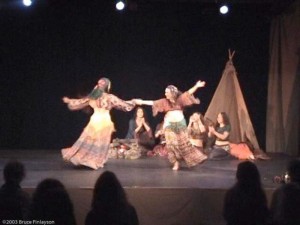
The dance in these videos is an interpretation of an historical style of dance and costume common in Egypt in the late 1800’s and into the 20th Century. Our choreography is based on historic photos and travellers’ writings about the Ghawazee, and our studies with Aisha Ali, Banat Mazin troupe members, and others.  The Ghawazee continue to perform today, though with different costumes! Many Ghawazee, and in particular those we studied for this piece, are members of Domari and Nawar tribes – that is, Middle Eastern branches related to the “Romani” (peoples who have asked to no longer be called “Gypsies”).  Ghawazee has been translated as “Invaders of the Heart” – but the word has some negative connotations, as it represents Egyptian women who dance to entertain. 

We are members of the B.C. dance collective “Re-Orient”, and we hope our performance, and these videos, will broaden your perspectives on Arab and Turkish arts and societies.  Videos are by Eric Boucher. 

Earthfire dance company

Belly Dance Fact & Fiction: References

OPA Showcase Lecture/seminar, Victoria BC – presented by Lynette Harper Ph.D. November 2013

References – Books (*specific articles cited)

Belly dance around the world: New communities, performance and identity. 2013. Caitlin E. McDonald & Barbara Sellers-Young, editors. Jefferson NC: McFarland & Company.

* What is Baladi about al-Raqs al-Baladi? On the survival of belly dance in Egypt, Noha Roushdy.

* Performing identity/diasporic encounters, Lynette Harper

* 1970s Belly dance and the “How-To” phenomenon: Feminism, fitness and Orientalism, Virginia Keft-Kennedy

* Local performance/global connection: American Tribal Style and its imagined community, Teresa Cutler-Broyles

* Quintessentially English belly dance: In search of an English tradition, Siouxsie Cooper

Belly dance: Orientalism, transnationalism & harem fantasy. 2005. Anthony Shay & Barbara Sellers-Young, editors. Costa Mesa CA: Mazda Publishers.

* Introduction, Anthony Shay & Barbara Sellers-Young

* Belly dance: An urban folk genre, Najwa Adra

* Body, image, identity: American Tribal Belly dance, Barbara Sellers-Young

* Spirit from the body: Belly dance as a spiritual practice, Donnalee Dox

Belly Dance Reader. 2012. Editors of the Gilded Serpent. Fairfax CA: Gilded Serpent.

* Belly dance & contemporary dance studies, Barbara Sellers-Young

* Orientalism: Zumarrad’s completely non-scholarly quick and dirty guide, Brigid Kelly

* “Harem Girls,” dance in historical harems, early 1700’s – early 1900’s, the perpetual masquerade, Andrea Deagon

Dancing fear & desire: Race, sexuality, & imperial politics in Middle Eastern Dance. 2004. Stavros Stavrou Karayanni. Waterloo ON: Wilfred Laurier University Press.

Gypsies and the problem of identities. 2002. Adrian Marsh & Elin Strand, editors. Istanbul: Swedish Research Institute in Istanbul, Transactions vol.17.

* Introduction,  Elin Strand & Adrian Marsh

* On Romany origins and identity – questions for discussion, Ian Hancock

* The current situation of the Dom in Jordan, Allen Williams

Looking for Little Egypt. 1994. Donna Carlton. Bloomington IN: IDD Books

Orientalism (25th Anniversary Edition). 1994. Edward Said. New York: Vintage Books.

Scheherezade goes West: Different cultures, different harems. 2001. Fatema Mernissi. New York: Washington Square Press.

Serpent of the Nile: Women and dance in the Arab world.  1989. New York: Interlink books.

Visibly Muslim: Fashion, politics, faith. 2010. Emma Tarlo. Oxford: Berg.

We are the Romani people. 2002. Ian Hancock. Hatfield: University of Hertfordshire Press.

You asked Aunt Rocky: Answers & advice about Raqs Sharqi & Raqs Shaabi. 2011. Morocco (C.Varga Dinicu). Virginia Beach VA: RDI Publications.

References cited – journal & internet articles

Dancing around Orientalism. 2006. Donnalee Dox. TDR/The Drama Review, Vol.50 no.4 (Winter 2006), pp.52-71.

Feminism and belly dance. Andrea Deagon. http://people.uncw.edu/deagona/raqs/feminism.htm (downloaded 18 Nov.2013)

In search of the origins of the dance. Andrea Deagon. http://people.uncw.edu/deagona/raqs/origins.htm (downloaded 18 Nov.2013)

Naked belly dance in Egypt? Part 1: Are they really belly dancing? 2009. Andrea Deagon. The Gilded Serpent, http://www.gildedserpent.com/cms/2009/10/19/deagonnakedbdpart1/ (downloaded 18 Nov.2013)

Oriental dance: Myth and reality, the harem slaves. 2002.  Jalilah Lorraine Chamas. The Gilded Serpent, http://www.gildedserpent.com/articles20/jalilahharamslaves.htm (downloaded 18 Nov.2013)


More books for dancers

Four essentials for a dancer’s bookshelf, published in the last two years:  Belly dance around the world: New communities, performance and identityThe belly dance readerGlobal moves – and You asked Aunt Rocky: Answers & advice about Raqs Sharqi & Raqs Shaabi.  Each book offers powerful ideas, analysis, and inspirations – and they’re available through Amazon!  I plan to update this post with a review of each book in the next few months!   Lynette, October 2013

Belly dance around the worldBelly dance around the world: New communities, performance and identity

Edited by Caitlin E. McDonald & Barbara Sellers-Young. Here’s the blurb from the back cover:

Dancer/scholars from around the world have contributed essays on belly dance to this book. They all carefully consider the transformation of an improvised folk form from North Africa and the Middle East into a popular global dance practice. The essays explore the differences between the solo improvisational forms of North Africa and the Middle East, often referred to as raqs sharki, which are part of family celebrations, and the numerous globalized versions of this dance form, belly dance, derived from the movement vocabulary of North Africa and the Middle East but with a variety of performance styles distinct from its site of origin. Local versions of belly dance have grown and changed along with the role that dance plays in the community. The global evolution of belly dance is an inspiring example of the interplay of imagination, the internet and the social forces of local communities.

Yes, that’s me and Rahma on the cover!  I have contributed a chapter  “Performing identity/Diasporic encounters”, based on interviews with Arab women dancers.

Belly dance reader


An outstanding anthology of articles put together by Gilded Serpent, under the leadership of editor Lynette Harris.


Aunt Rocky


Astonishing – Morocco has assembled a lifetime of philosophy, research, ideas, and advice about dance inside the covers of this book!


global moves


I’m looking forward to reading this book by Caitlin McDonald, ” a study of how dancers throughout the world use Egypt as a reference point for situating themselves within the global belly dance community and how Egypt gets romanticized and fantasized in global narratives about belly dance.”

Bekaa Valley Girls

Several excerpts from Bekaa Valley Girls, Lynette’s full-length collaborative creation with Rahma Haddad, presented in the Noon Dance Seriesat Vancouver’s Dance Centre, November 2009.


Duet with Rahma Haddad (part 1)

This segment recalls when Lebanese cousins Lynette and Rahma first met.  Though raised in different parts of Canada, they shared a family history of immigration and a deep love of dance.

Duet with Rahma Haddad (part 2)

This excerpt from Bekaa Valley Girls continues from Part 1.  Rahma presents Lynette with a hipscarf, and introduces her to belly dance.


Gnossienne

In this excerpt, Lynette wonders if she has missed something in her western dance training.


Nanaimo dancers & teachers


Lynette  250-753-1659  laahper@gmail.com

Genya  250-739-0589  genyasdancing@gmail.com

Ramona  250-616-3824  Ramona@bellydancer.ca

Giselle Jacob – Drum & percussion classes available  – see her Facebook page


Crimson Coast Dance Society  Artistic Director Holly Bright, Nanaimo, BC – Develops and supports contemporary dance creations, productions, performances and educational opportunities at both grass roots and professional levels in Central Vancouver Island.

Arab music understanding

Egyptian music appreciation and practice for bellydancers

by George Dimitri Sawa

A must-have for dancers, teachers, and students who wish to develop their understanding of Egyptian music!   The quality of the package is awesome – exceeding my already high expectations of  creator George Sawa, an Egyptian born historian, musicologist, qanun virtuoso, a true master of Arabic Music. He has taught generations of dancers and musicians, and we are so lucky that this gracious gentleman is sharing his knowledge in this new format.

(package includes a comprehensive 4-chapter manual: 2 CDs, 65 tracks, 21 rhythms and cymbal patterns; 8 maqams; photographs and description of 32 musical instruments; 6 musical forms.)

Order this and other CD’s direct from George Sawa’s website.

Arab dance workshops

TARAB – Arab music and spirit of the dance

Explore the soul and vitality of Arab music as inspiration for dance improvisation and choreography. Teaching level: Multilevel; works well for mixed levels beginner through advanced. Read review. Length: 2 or 3 hours

From Countryside to Cabaret: Egyptian Saidi and Raqs Sharqi styles

Build your technique, movement vocabulary, and understanding of two popular Egyptian dance styles. Discover the links between the informal village dances of Saidi, and the performance-oriented precision of glamorous Raqs Sharqi dance. Teaching level: Adaptable to any level, or multi-level teaching.  Length: 2 to 5 hours.

Zar: Dancing with Spirit

Zar is a type of spirit, an illness caused when spirits possess humans, and a ritual conducted to pacify the spirits. For Arab women, zar is not an exorcism but a way of “realigning” their daily world with the spirit world. Learn about the zar and its rituals, then explore traditional zar movements and their creative possibilities for dance performance. Options: May be accompanied by a lecture and a-v showing, and/or a folkloric dance choreography with the Egyptian song “Salamit’ha Um Hassan”.  Teaching level: Multilevel.  Length: 1 1/2 for basic introduction, movements, and simple choreography. Up to 3 hours with additional options.

Dance is in their blood


Gilded Serpent June 2007         

by Kevin Potvin

A reluctant visitor to a multicultural arts show comes away with a new appreciation for how art entwines with ordinary life for ordinary people. . . . (click here to read article)

Excerpt: That doesn’t mean I don’t understand dance at all – as a form of art done by artists, or as an activity people do at clubs.  Haddad presented a different thing I had previously bean unaware of, and it bridged the two forms – art and popular pastime – to form a third distinct thing: popular art, or folk art, in dance form.  This was no contrived presentation of foreign exoticism to satisfy some state-granting agency looking to spice up multicultural awareness week. This was a moving and utterly personal expression given in so highly evolved a form, it appeared to be fully grounded in the Earth.

It was Lynette Harper’s talk and performance that, though it came first, served to wrap up the whole of the noon hour’s entertainment–which was fitting since she organized this show. Harper spoke in general terms of how belly dancers share their dances with each other, and how they get caught up in each other’s pleasure of dancing. “At any gathering,” she emphasized, “there was always dance; it was loved and honoured.” . . .
(previously posted in The Republic of East Vancouver, April 2004)

(See short clip “Arab Women Arab Dance” in Video section)


Lynette Harper Workshop Review


OPA! News, Victoria Spring 2008

by BOBBIE BARRY

Lynette is the quintessential teacher. After 30 years of teaching and performing this art form, she knows her stuff!

My first meeting and experience of Lynette Harper as a teacher was back in July 2003.  At that point I had been studying Middle Eastern belly dance for a year and a half.  My first teacher and Mentor, Pamela Ball asked Lynette to travel down from Nanaimo to do a workshop with those of us who had fallen under the thrall of this beautiful dance form.

Pamela told us we were in for a treat and a treat is what we got.  Though I still consider myself in the toddler stages of my study of this dance, back then as a baby dancer, I remember being very nervous taking a class outside the comfort zone of my own teacher’s methods and style.

But not to worry.  Lynette is the quintessential teacher.  After 30 years of teaching and performing this art form, she knows her stuff!  And without being overbearing or forcefully opinionated, it is clear that she expects you to continue your own education if you are a seriously dedicated student.  On the other hand, she is encouraging, supportive and very generous with her knowledge and skill towards those of us who are still in the learning process.

My first experience of Lynette as a performer was in that same workshop back in July 2003.  It was exciting to see her earthy, confident Rom style!  Since then I have seen Lynette perform other styles of dance at various events and venues around the Victoria area.  I always enjoy her wonderful stage presence.  Whether, celebratory, playful, introspective or any myriad of other moods, I always find her performances fresh and in the moment.  She is always genuine for the audience and I love that in a performer.

So with that in mind, I eagerly looked forward to another fun, informative and expressive  day on December 1st.

The workshop was held at the Pro Patria Legion.  First, let me say it was a really nice venue.  Nothing fancy but easily located with plenty of accessible parking (I live close by so that was an added bonus), with a Tim Horton’s and a few other restaurants within walking distance.

We started the “Raqs Sharqi” morning workshop by warming up with folkloric steps and movements.  This not only served to get us moving and the blood flowing but gave us a base from which to discuss the origins of Raq Sharqi (Oriental dance).  From there we began to refine those steps, form them into combinations and add more detailed arms and hands.  We discussed and implemented intention in our movement – being aware that the just-for-fun, spontaneous social aspects of the Beledi (country) dance becomes more intentional, elegant and stylized as it moves towards engaging and entertaining an audience in the classical and modern styles of Oriental dance.

We ended the morning by learning a small portion of a Randa Kamal choreography as taught at the 2007 International Bellydance Conference of Canada.  It certainly was a lesson on the innovative modern Egyptian style developed by Randa – showing that this dance is certainly not static!

After the short lunch break we reconvened for the “Turkish Inspirations” afternoon portion of the workshop.  This was the portion in which I was particularly interested as I feel that my own personal style leans more towards American Cabaret that, in the past, borrowed heavily from Turkish music, styling and costuming.

In this portion we discussed “earthiness” and “airiness” – how we might flow between the two energies and where we feel our personal style lies along the continuum between the two.  Lynette even had us place ourselves along an imaginary line between “earthy” and “airy.”  That was a very interesting and profound moment.  Some dancers’ perception of their particular place on the continuum was not how they were perceived by the other students!  Food for thought there!  We spent some time paying particular attention to hands and emotion.  We also discussed, practiced and experimented with spins, pauses and poses at various speeds and levels.  These provide that dramatic flair that, to me, is characteristic of Turkish style and which gives such rich texture to a performance (though it is, of course, present in other styles as well).

Though we followed Lynette’s direction and instruction, she also gave time and room for improvised expression.  For me, this is the essence of Middle Eastern dance.  Learning choreography and combinations are fun, useful and, for me, a necessary way to hone technique and transitions beyond the drilling stage.  However, just as each person is unique, expression through dance is also unique.  Each dancer must be able to come to a point where she/he is able to translate what the music is saying to her/him.  Lynette’s teaching never loses sight of this important truth and she always makes room for even the least experienced and proficient dancer to begin to find that individual expression.

Lynette ended both sessions with a stretch and emphasized throughout the day to modify movement or use similar but different movement to accommodate existing personal physical injuries or conditions.

In addition, the music used was excellent and made available by mail to those who wished to purchase.

My only suggestion goes to OPA not Lynette:  I was very happy to pay for and attend the full day workshop.  However, I did have a few people mention to me that they would have liked to attend either the morning or the afternoon sessions because personal commitments did not allow for freeing up an entire day.  I know it’s a lot of work to put on any function and have it run smoothly and successfully.  When all is said and done it’s nice to see that hard work pay off in attendance and participation.  Perhaps providing the option to pay and attend only one of the sessions would have seen a few more people at these most fun and informative classes.

Having one of Vancouver Island’s own teaching a workshop was a great way to celebrate 10 years since OPA’s inception.  A BIG thank you to Lynette and OPA.


Arab Women Arab Dance

Arab Women Arab Dance

Opening of Arab Women Arab Dance, presenting life histories with dance. Featuring Lynette, Rahma Haddad, Salma Ferchichi, Rabab Ward, and Emily Basha. Produced by Vancouver’s Dance Centre.

Excerpt from a Vancouver Dance Centre production, interweaving life history narratives with demonstrations by five Arab women.

Books for dancers

READ THIS BOOK!!!!

Belly dance: Orientalism Transnationalism and Harem Fantasy

edited by Anthony Shay and Barbara Sellers-Young


For over a century, solo improvised dance, especially belly dance, has had enormous popularity, and by the 1970s and 1980s in the wake of the feminist movement, over a million women in the United States, and many more thousands in Western Europe became devotees of this choreographic form. This volume traces several strands of this phenomenon. Anthony Shay and Barbara Sellers-Young provide an overview of solo improvised dance in the Middle East and in the West. 

Several essays address the dance tradition in the Middle East: Najwa Adra describes and analyzes the performance of solo improvised dance in domestic circles in the Arab world, Anthony Shay analyzes the issue of how Islam and individuals among the Moslem clergy perceive and react to dance, Stavros Stavrou deconstructs the famous encounter between Gustave Flaubert and the Egyptian dancer Kuchek Hanum in terms of colonialism, Roberta Dougherty analyzes the popular images of the belly dancer in the Egyptian cinema, Shay addresses the question of male dancers and their performances, and Linda Swanson adds a whimsical interpretation of the famous twentieth century Egyptian belly dancer Tahia Carioca. 

The dance was frequently seen in the West by millions of visitors to world fairs and exhibitions that were popular in the 19th century and Sol Bloom, the entrepreneur of the Chicago World Fair of 1893 coined the term “belly dance.” From that period, belly dance became a popular entertainment in the United States. American women found the dance to be a liberating vehicle and a means of adopting new and exotic persona. They developed several new genres of the dance. Barbara Sellers-Young describes and analyzes tribal belly dance, a genre that was invented in San Francisco, Anne Rasmussen provides an overview of the music used in Arab nightclubs in the United States and a description of the musicians and the club milieu, Donnalee Dox analyzes the spiritual belly dance movement, Andrea Deagon addresses the enduring trope of oriental dance: Salome’s Dance of the Seven Veils through performances both from the turn of the century and contemporary versions, Nancy Lee Ruyter gives a historical perspective of La Meri’s, one of the earlier interpreters of belly dance, Jennifer Fisher looks at the orientalist implications of the Arabian dance from the Nutcracker, often inspired by oriental dancing and seen by millions of audience members across America. An epilogue by the editors provides an overview of the topic and integrates the scholarly material for the reader. [publisher’s notes)

Check out details and order a copy from Mazda Publishers.

Unveiled: Performing identities in the Arab diaspora

Bellydance AtW book cover

On Canada’s west coast, a large and active bellydance community has grown and thrived distinct from Middle Eastern ethnic communities.  Orientalist fantasies and Egyptian stylings regularly appear onstage alongside western tribal and other ethnic bellydance fusions.  These performances do not challenge popular media stereotypes about the Middle East; they comfortably coexist with ideologies linking veiled Arab women with oppressed victims of patriarchy and war.  So how do Arab women immigrants and their descendants experience and negotiate issues of identity and representation within the bellydance community?  Do they resist or reinscribe notions of difference, authenticity, traditionalism, contemporaneity?

In 2010 & 2011, I conducted ethnographic interviews with Arab women who belly dance. Their narratives reveal the strategies and tensions of negotiating social identities within west coast bellydance and ethnic communities.

Findings are now available in an academic publication of belly dance research, Belly Dance Around the World: New communities, performance and identity, in the chapter titled   Arab/Other: Performing identities on Canada’s west coast.


Arab Women, Arab Dance

Raks Araby Kevin colourWhen most people think of Arab music and dance they usually think of bellydancing, the North American dance craze based on an ancient tradition. These two presentations at Vancouver’s Dance Centre (2004 & 2005) provided a personal and cultural context for understanding the dynamic and evolving art of Arab dance.  Five diversely accomplished Arab women, well known as teachers and performers, explored their dance form through words and movement.  We revealed the meaning of Arab dance as art, cultural expression, and source of personal identity.

Each of the presenters has a unique history, their origins reflecting the diversity of the Arab world and the Arab diaspora. During the first informal event in 2004, Salma Ferchichi, Rahma Haddad, Lynette Harper and Rabab Ward spoke about self and identity as it relates to their Arab dance teaching and performance.  The following year, 2005, Emily Basha joined the group.  OOn both occasions, our words were accompanied by short performances, and a group improvisation that conveys the joyful social dimension of Arab dance. In 2005, co-organizer Rahma Haddad produced a series of dance workshops featuring all five presenters.

These events integrated masterful professional performances of diverse Middle Eastern and North African dance styles with insightful personal narratives. They were a first for the B.C. dance community – and perhaps for Canada – in presenting Arab perspectives about Arab women and their dance.  The 2004 performance was reviewed in Vancouver newspaper The Republic and Gilded Serpent.

Press Release from the Dance Centre, 2004


The Dance Centre presents 

The Noon Dance Series

Raks Araby – Arab Women, Arab Dance

With Salma Ferchichi, Rahma Haddad, Lynette Harper and Rabab Ward

Insightful narratives with masterful performances of

Middle Eastern and North African dances

Friday March 26 2004 at 12 noon

Scotiabank Dance Centre, 677 Davie St (at Granville), Vancouver

Tickets $7 at the door Info: 604 606 6400 www.thedancecentre.ca

Followed by a tour of Scotiabank Dance Centre at 1pm

The monthly Noon Dance Series continues with a unique and stimulating presentation of Middle Eastern and North African dance forms, by four diversely accomplished Arab women. Salma Ferchichi, Rahma Haddad, Lynette Harper and Rabab Ward go beyond the popular preconceptions of bellydancing, to reveal Arab dance as a dynamic and evolving art, means of cultural expression, and source of personal identity.

During this informal event Salma, Rahma, Lynette and Rabab will speak and perform, exploring self and identity as it relates to their Arab dance teaching and performance.  Their aim is to facilitate new understandings about the vitality of dance in the lives of women of Arab origin in Canada, and to challenge audience preconceptions about both Arab women and bellydancing.

Exploring Tarab with Lynette


Spring 2007  OPA! News, Victoria      by Sidona

On February 18th members of Women of Widad piled into a van to take the trip up to Nanaimo to attend a workshop with Lynette Harper. 

 We were excited and all felt that we needed a burst of dance energy after the long winter and also to beat the February blues. When we arrived at the Harbour Dance Centre in Nanaimo we were pleasantly surprised by the sunshine streaming through the windows and bouncing playfully off the hardwood floors. One of the topics discussed was “Tarab” and none of us really knew what that meant.

Lynette started with a warm-up with all of us in a circle facing each other. We moved on to “Turkish Curves” using a smoky Turkish song that really got us into that slow syrupy movement. She started with some examples and then had each of us pick a part of our body to focus on for several minutes. IT was a real joy to explore our inner emotions and combine it with a dance. Lynette promotes dance as a whole woman experience. In her workshops you are pushed out of your comfort zone in a comfortable way. She then did a mini-Ghawazee workshop called “Ghawazee Sparkle”.

The rest of the afternoon was spent on “Tarab” which when translated means “Art is Feeling” or is also described as a “musically induced state of ecstasy”. The dancers were asked to describe what they felt when dancing and words were tossed back and forth like, Freedom, Revitalized, Divine Feminine, Health, In my Veins. We moved energy to different parts of our bodies and explored alone and with other dancers using “light” and “heavy” movements, infectious music and complementary movements. It was a delight and as a group we all felt richer as dancers and as women.

It is vital to express our full selves as we dance and Lynette facilitated in her warm and welcoming way an excellent day of playing in the sun. As we drove home we felt fuller and more complete as dancers. Thank-you Lynette!