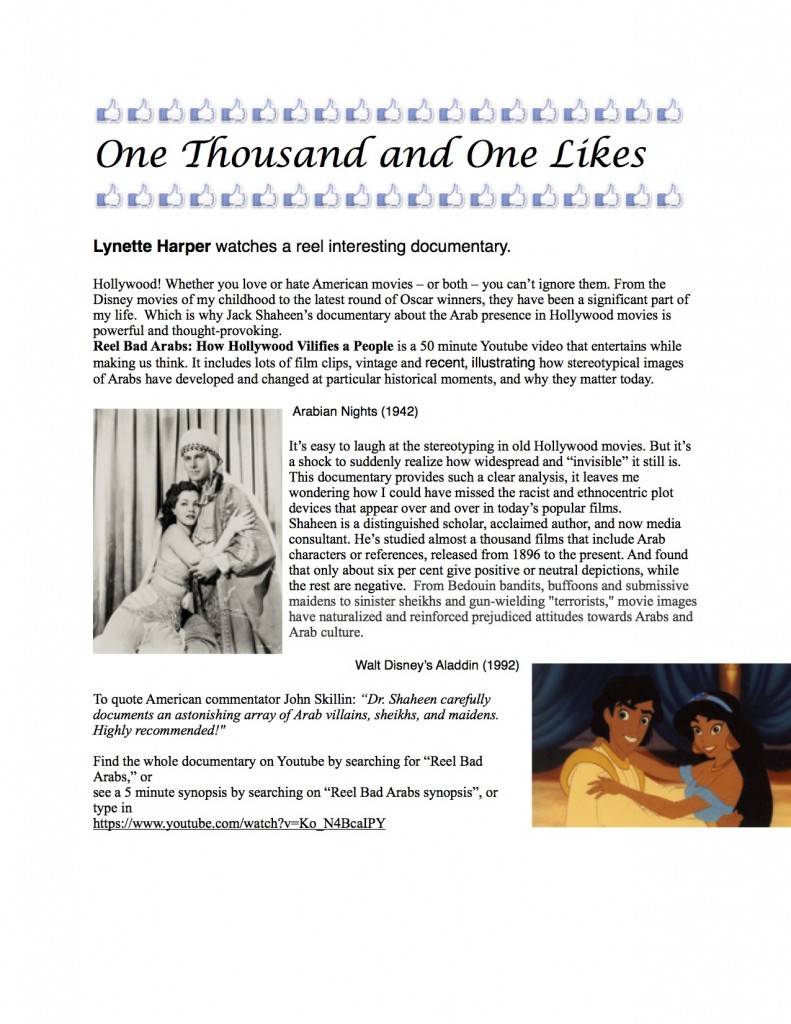
Lynette Harper watches a reel interesting documentary. Reprinted with permission from the Middle Eastern Dance Association newsletter, Sahda, May 2014.
Dance like there is no tomorrow
Lynette Harper watches a reel interesting documentary. Reprinted with permission from the Middle Eastern Dance Association newsletter, Sahda, May 2014.
by George Dimitri Sawa
A must-have for dancers, teachers, and students who wish to develop their understanding of Egyptian music! The quality of the package is awesome – exceeding my already high expectations of creator George Sawa, an Egyptian born historian, musicologist, qanun virtuoso, a true master of Arabic Music. He has taught generations of dancers and musicians, and we are so lucky that this gracious gentleman is sharing his knowledge in this new format.
(package includes a comprehensive 4-chapter manual: 2 CDs, 65 tracks, 21 rhythms and cymbal patterns; 8 maqams; photographs and description of 32 musical instruments; 6 musical forms.)
Order this and other CD’s direct from George Sawa’s website.
Elizabeth Warnock Fernea, Random House, re-issue 1995
Though Elizabeth Warnock Fernea’s book was first published in 1969, her writing provides useful insights into daily life, for Arab women in a particular place (rural Iraq) and time period. “A delightful, well-written, and vastly informative ethnographic study, this is an account of Fernea’s two-year stay in a tiny rural village in Iraq, where she assumed the dress and sheltered life of a harem woman.” (Random House website)
Reading “Guests of the Sheik” left me in tears. My father was born and raised in southern Iraq right around the time that Elizabeth Warnock Fernea moves there. I grew up on stories from that period and I appreciated getting the women’s story from this book, it felt like a complement of the stories I heard in childhood. As I read “Guests of the Sheik” I frequently wondered how I would react if I was in Elizabeth Warnock Fernea shoes. Would I feel at home in that environment? Would I feel as a tourist? I don’t know, but I do hope that one day when I do visit Iraq that I will feel as much love for the land and its people as Elizabeth Warnock Fernea did. (Amazon website review)
 Minor Empire – Second Nature
Great music for listening and dancing – this new album of Turkish / world music is made in Toronto! I couldn’t stop dancing during the Minor Empire set at the Islands Folk Festival last summer, where the whole crowd was mesmerized by Ozgu’s truly enchanging vocals. Guitarist/composer Ozan describes their style not as a fusion of Turkish and Western music, but the result of both a collision and confluence of these disparate elements. “I see them as coexisting together while keeping their original shapes,” he explains. “We definitely kept the original vocal melodies while fitting them into modern song forms we composed.” Minor Empire has already been named World Group of the Year at 2011 Canadian Folk Music Award, and I hope to hear more albums in the near future!
“Second Nature is more than just an interesting record, it marks an important way forward for Turkish and world music, in general…” (Errol Nazareth, CBC Radio and Toronto Sun music columnist.)
 Souad Massi
I love every album featuring Souad Massi, “a leading light among young Algerian artists”. Her fine voice, activism, and courage have brought her into the limelight. A singer, songwriter, and guitarist, Souad creates delicate Algerian folk rock with sensitive lyrics. She comes from a family of performers, and was born in Algiers in 1972. Her elder brother is a composer, her younger brother a musician and her little sister is a dancer. I find myself deeply touched by her songs, whether she singing in Arabic or French (she very occasionally sings in English or Kabyle [Berber]).
If Souad Massi didn’t exist, surely the world-music community would have had to invent her. A doe-eyed, twentysomething Algerian singer/songwriter with a carillon-like voice and fine line in heartfelt, political songs, her debut album Raoui (The Storyteller) has seen her compared with artists such as Joan Baez and Joni Mitchell and – despite singing only in Arabic and French – hailed as a major star in the making. (Jane Cornwell, London Evening Standard, 22 April 2002)
A veil of mystery and stereotyping obscures Arab women’s lives in the Middle East and the global Arab diaspora. This course investigates Arab women’s dilemmas and perspectives on identity, faith, politics and representation through readings and discussion based on ethnographies and cultural studies. Examine gender/power relations in Arab cultural contexts in the Middle East and diaspora; rethink Orientalism; explore diverse voices, hybridity, modernity, community, tradition and contemporary media.
Adely, Fida. (2012). Gendered paradoxes: Educating Jordanian women in nation, faith and progress. Chicago: University of Chicago Press.
PLUS ONE Optional ethnography, to be assigned:
Abu-Lughod, L. (1999). Veiled sentiments: Honor and poetry in a Bedouin society. Berkeley CA, University of California Press.
Abu-Lughod, L. (1993). Writing women’s worlds: Bedouin stories. Berkeley CA, University of California Press.
Deeb, L. (2006). An enchanted modern: Gender and public piety in Shi’i Lebanon. Princeton, Princeton University Press.
Fernea, E. W. (1969). Guests of the sheik: An ethnography of an Iraqi village. Garden City NY, Doubleday & Company.
Tarlo, E. (2010). Visibly Muslim: Fashion, politics, faith. New York, Berg
30% Five Critical Responses to class videos, textbook chapters and articles
Your Responses should be more than summaries or descriptions. Critically examine and comment on each video or text, noticing biases and assumptions in your own analysis as well as in the video or text itself. Be reflective and support your opinions with reference to class readings and discussions, anthropological frameworks and/or personal experiences. Each Response should be approximately two pages (typed and double-spaced), and demonstrate your understanding of and engagement with the material.
5% Panel discussion & informal presentation of Assigned Journal Article
15% Team presentation of assigned ethnography
Groups of 5-7 students will collaboratively prepare a presentation on an assigned ethnography to the class. Time will be provided during class for team preparation.
Your team is responsible for teaching the book to the rest of the class. A group mark will be awarded based on instructor, peer, and self-evaluations.
20% Critical Essay on assigned text
This assignments has two objectives: to allow you to explore significant themes and ideas in greater depth, and to develop and demonstrate your ability to critically read and analyze an ethnography. Your analysis should be well supported by evidence from multiple sources.
20% Final open book essay exam (take-home or in- class option)
Write two short essay responses to questions selected from the provided list. You may bring books, articles, and notes. No computer or digital devices are permitted, except by advance permission of instructor.
10% Class participation and attendance
Participation marks will be based on your attendance and contribution to class discussions and activities. Although a small portion of your final mark, if yours is a borderline case this could be a letter grade difference. The starting point for your participation mark will be your current class average; the quality of your participation has the potential to raise or lower your mark a letter grade (e.g. from B+ to A- ).
Required readings must be read before class. Everyone should come to class prepared to discuss the assigned readings. Students are expected to attend all scheduled classes, and to actively participate in class discussions. If you must miss a class, please try to inform the instructor BEFORE it begins.
 When most people think of Arab music and dance they usually think of bellydancing, the North American dance craze based on an ancient tradition. These two presentations at Vancouver’s Dance Centre (2004 & 2005) provided a personal and cultural context for understanding the dynamic and evolving art of Arab dance. Five diversely accomplished Arab women, well known as teachers and performers, explored their dance form through words and movement. We revealed the meaning of Arab dance as art, cultural expression, and source of personal identity.
Each of the presenters has a unique history, their origins reflecting the diversity of the Arab world and the Arab diaspora. During the first informal event in 2004, Salma Ferchichi, Rahma Haddad, Lynette Harper and Rabab Ward spoke about self and identity as it relates to their Arab dance teaching and performance. The following year, 2005, Emily Basha joined the group. OOn both occasions, our words were accompanied by short performances, and a group improvisation that conveys the joyful social dimension of Arab dance. In 2005, co-organizer Rahma Haddad produced a series of dance workshops featuring all five presenters.
These events integrated masterful professional performances of diverse Middle Eastern and North African dance styles with insightful personal narratives. They were a first for the B.C. dance community – and perhaps for Canada – in presenting Arab perspectives about Arab women and their dance. The 2004 performance was reviewed in Vancouver newspaper The Republic and Gilded Serpent.
Press Release from the Dance Centre, 2004
The Dance Centre presents
The Noon Dance Series
Raks Araby – Arab Women, Arab Dance
With Salma Ferchichi, Rahma Haddad, Lynette Harper and Rabab Ward
Insightful narratives with masterful performances of
Middle Eastern and North African dances
Friday March 26 2004 at 12 noon
Scotiabank Dance Centre, 677 Davie St (at Granville), Vancouver
Tickets $7 at the door Info: 604 606 6400 www.thedancecentre.ca
Followed by a tour of Scotiabank Dance Centre at 1pm
The monthly Noon Dance Series continues with a unique and stimulating presentation of Middle Eastern and North African dance forms, by four diversely accomplished Arab women. Salma Ferchichi, Rahma Haddad, Lynette Harper and Rabab Ward go beyond the popular preconceptions of bellydancing, to reveal Arab dance as a dynamic and evolving art, means of cultural expression, and source of personal identity.
During this informal event Salma, Rahma, Lynette and Rabab will speak and perform, exploring self and identity as it relates to their Arab dance teaching and performance. Their aim is to facilitate new understandings about the vitality of dance in the lives of women of Arab origin in Canada, and to challenge audience preconceptions about both Arab women and bellydancing.