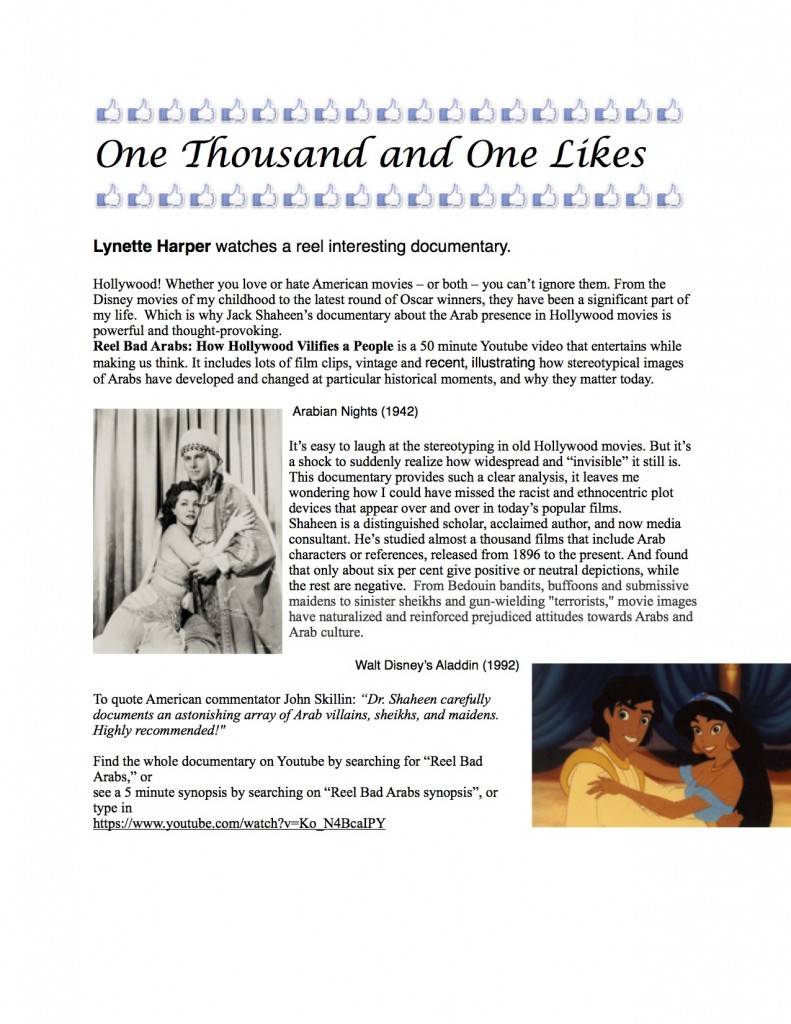
Lynette Harper watches a reel interesting documentary. Reprinted with permission from the Middle Eastern Dance Association newsletter, Sahda, May 2014.
Dance like there is no tomorrow
Lynette Harper watches a reel interesting documentary. Reprinted with permission from the Middle Eastern Dance Association newsletter, Sahda, May 2014.
Lynette Harper appreciates the values embedded in hula. Reprinted with permission from the Middle Eastern Dance Association newsletter, Sahda, March 2014.


Belly dance around the world: New communities, performance and identity. 2013. Caitlin E. McDonald & Barbara Sellers-Young, editors. Jefferson NC: McFarland & Company.
* What is Baladi about al-Raqs al-Baladi? On the survival of belly dance in Egypt, Noha Roushdy.
* Performing identity/diasporic encounters, Lynette Harper
* 1970s Belly dance and the “How-To” phenomenon: Feminism, fitness and Orientalism, Virginia Keft-Kennedy
* Local performance/global connection: American Tribal Style and its imagined community, Teresa Cutler-Broyles
* Quintessentially English belly dance: In search of an English tradition, Siouxsie Cooper
Belly dance: Orientalism, transnationalism & harem fantasy. 2005. Anthony Shay & Barbara Sellers-Young, editors. Costa Mesa CA: Mazda Publishers.
* Introduction, Anthony Shay & Barbara Sellers-Young
* Belly dance: An urban folk genre, Najwa Adra
* Body, image, identity: American Tribal Belly dance, Barbara Sellers-Young
* Spirit from the body: Belly dance as a spiritual practice, Donnalee Dox
Belly Dance Reader. 2012. Editors of the Gilded Serpent. Fairfax CA: Gilded Serpent.
* Belly dance & contemporary dance studies, Barbara Sellers-Young
* Orientalism: Zumarrad’s completely non-scholarly quick and dirty guide, Brigid Kelly
* “Harem Girls,” dance in historical harems, early 1700’s – early 1900’s, the perpetual masquerade, Andrea Deagon
Dancing fear & desire: Race, sexuality, & imperial politics in Middle Eastern Dance. 2004. Stavros Stavrou Karayanni. Waterloo ON: Wilfred Laurier University Press.
Gypsies and the problem of identities. 2002. Adrian Marsh & Elin Strand, editors. Istanbul: Swedish Research Institute in Istanbul, Transactions vol.17.
* Introduction, Elin Strand & Adrian Marsh
* On Romany origins and identity – questions for discussion, Ian Hancock
* The current situation of the Dom in Jordan, Allen Williams
Looking for Little Egypt. 1994. Donna Carlton. Bloomington IN: IDD Books
Orientalism (25th Anniversary Edition). 1994. Edward Said. New York: Vintage Books.
Scheherezade goes West: Different cultures, different harems. 2001. Fatema Mernissi. New York: Washington Square Press.
Serpent of the Nile: Women and dance in the Arab world. 1989. New York: Interlink books.
Visibly Muslim: Fashion, politics, faith. 2010. Emma Tarlo. Oxford: Berg.
We are the Romani people. 2002. Ian Hancock. Hatfield: University of Hertfordshire Press.
You asked Aunt Rocky: Answers & advice about Raqs Sharqi & Raqs Shaabi. 2011. Morocco (C.Varga Dinicu). Virginia Beach VA: RDI Publications.
Dancing around Orientalism. 2006. Donnalee Dox. TDR/The Drama Review, Vol.50 no.4 (Winter 2006), pp.52-71.
Feminism and belly dance. Andrea Deagon. http://people.uncw.edu/deagona/raqs/feminism.htm (downloaded 18 Nov.2013)
In search of the origins of the dance. Andrea Deagon. http://people.uncw.edu/deagona/raqs/origins.htm (downloaded 18 Nov.2013)
Naked belly dance in Egypt? Part 1: Are they really belly dancing? 2009. Andrea Deagon. The Gilded Serpent, http://www.gildedserpent.com/cms/2009/10/19/deagonnakedbdpart1/ (downloaded 18 Nov.2013)
Oriental dance: Myth and reality, the harem slaves. 2002. Jalilah Lorraine Chamas. The Gilded Serpent, http://www.gildedserpent.com/articles20/jalilahharamslaves.htm (downloaded 18 Nov.2013)

Four essentials for a dancer’s bookshelf, published in the last two years: Belly dance around the world: New communities, performance and identity – The belly dance reader – Global moves – and You asked Aunt Rocky: Answers & advice about Raqs Sharqi & Raqs Shaabi. Each book offers powerful ideas, analysis, and inspirations – and they’re available through Amazon! I plan to update this post with a review of each book in the next few months! Lynette, October 2013
 Belly dance around the world: New communities, performance and identity
Edited by Caitlin E. McDonald & Barbara Sellers-Young. Here’s the blurb from the back cover:
Dancer/scholars from around the world have contributed essays on belly dance to this book. They all carefully consider the transformation of an improvised folk form from North Africa and the Middle East into a popular global dance practice. The essays explore the differences between the solo improvisational forms of North Africa and the Middle East, often referred to as raqs sharki, which are part of family celebrations, and the numerous globalized versions of this dance form, belly dance, derived from the movement vocabulary of North Africa and the Middle East but with a variety of performance styles distinct from its site of origin. Local versions of belly dance have grown and changed along with the role that dance plays in the community. The global evolution of belly dance is an inspiring example of the interplay of imagination, the internet and the social forces of local communities.
Yes, that’s me and Rahma on the cover! I have contributed a chapter “Performing identity/Diasporic encounters”, based on interviews with Arab women dancers.

An outstanding anthology of articles put together by Gilded Serpent, under the leadership of editor Lynette Harris.

Astonishing – Morocco has assembled a lifetime of philosophy, research, ideas, and advice about dance inside the covers of this book!

I’m looking forward to reading this book by Caitlin McDonald, ” a study of how dancers throughout the world use Egypt as a reference point for situating themselves within the global belly dance community and how Egypt gets romanticized and fantasized in global narratives about belly dance.”
 Fall 2012 Cultural Anthropology
Nanaimo: 8:30 – 11:30 am Fridays
Cowichan 10:30 am – 12 noon Mondays, Wednesdays
Instructor: Lynette Harper, Ph.D.
Email: Lynette.Harper@viu.ca
Anthropology can be divided into four subfields: physical/biological anthropology, archaeology, linguistic anthropology, and cultural anthropology. This course focuses on cultural anthropology—examining the nature of culture, the many social institutions that make us human, culture change, and anthropology in a globalizing world.
Instruction includes lectures, films, class discussions and cooperative activities. Evaluation will be based on:
Required text:
Haviland, William A., Harald E.L. Prins, Dana Walrath, and Bunny McBride. 2011. Anthropology: The Human Challenge, Thirteenth Edition. Belmont, CA: Wadsworth/Thomson Learning. (Note: Twelfth Edition may be used, though page numbers differ.)
| Weeks |
Topics, quizzes & assignments due |
Readings & Assignments due |
| Week 1 | Introductions, Anthropology & Four Fields, -Video: Everybody’s ethnic: Your invisible culture GN 357 E94 2001 | Read Chapter 1(read after class) |
| Week 2 | The culture concept, Video: Sacred Geography (45 min.) Light at the edge of the world series GN 320 L54 2009 | Chapter 14 |
| Week 3 | Ethnographic Research, Video: How cultures are studied, 30 min GN 316 F3 NO.03 | Chapter 15 |
| Week 4 | Learning culture, Language and Communication, Video: First Voices | Excerpts from Ch.16 & 17 |
| Week 5 | Sex, Marriage, Family – Video: Saheri’s Choice, 27 min. HQ 670 S33 1998 Cowichan Campus Library | Chapter 20 |
| Week 6 | Social organization: Kinship – Gender, age, interest, class – Optional Video: Arab diaries, 30 min | Chapter 21 |
| Week 7 | Midterm quiz – Video: Paris is Burning, 76 min. PN 1997 P37 1992 | Chapter 22 (read after class) |
| Week 8 | Social identity, Subsistence & Economics systems – Video: Potlatch, 22 min E 78 C2 F5.77 # 3 | Presentations due – Excerpts from Ch. 18,19 |
| Week 9 | Processes of change – Video: N’ai: story of a !Kung woman, 58 min DT 1058 K86 N32 2004 | Chapter 26 |
| Week 10 | Politics, power, and violence – Video: Raised to be heroes, 40 min. UB 345 I75 R35 2006 | Kinship essay due Chapter 23 |
| Week 11 | Power / change, Global Challenges, Local Responses – Video: Hunters of the Northern Ice, 45 min. GN 320 L54 2009 Light at the edge of the world series | Excerpts from Ch. 27 |
| Week 12 | Arts or Religion & Spirituality – Video: TBA | Excerpts from Ch.24 or 25 |
| Week 13 | Class review & wrap-up, Final take-home distributed | |
| Dec. 10 |
Final take-home essay exam due. Paper copies to 356-374, or drop box beside office 356-310. Exams may be emailed by advance arrangement. |
|
Attendance: Students are expected to attend all scheduled classes. Please notify the instructor in advance if you need to miss a class, in advance if possible. In exceptional circumstances (e.g., verifiable ill-health) it will be possible to make up the Reflective Note mark by special arrangement.
Participation in class activities: Do your reading BEFORE class begins. Come prepared to discuss the required readings. We all learn from exchanging ideas in the classroom, as well as from independent reading and analysis. You will complete a self-evaluation of your participation during class.
During most classes, you will be asked to handwrite a reflective comment based on a required reading, video, lecture or class discussion. The instructor will assign topics for each Note, to be handed in at the end of class.
Notes should NOT be simply a summary of information. For a good mark, be reflective and explain your opinions. If possible, incorporate anthropological ideas from class and your textbook. Your notes provide an opportunity for us to communicate directly, providing me with a better sense of what you are gaining from the course. I will always read your notes, and sometimes respond with written comments.
Please date and sign each Reflective Note with your first and last name. Notes will usually be returned within a week. Proper grammar and spelling are appreciated, though this will not affect your grade. You may hand in loose pages or a notebook. If you submit all 12 notes, you will automatically receive 12/20 marks. The remaining 8 marks will be based on quality and effort.
You will be assigned a topic with 2-3 other students, and given time in class to prepare a brief (5 minute) summary of one mode of subsistence or economic system described in the textbook, including its implications for social organization. Marks will be earned by demonstrating good organization and accurate understanding, providing good explanations and examples, and using visual aids (eg. blackboard or flipchart paper).
The purpose of this assignment is to explore ideas of family and kinship, kin terminology, and kindred. It consists of three parts: A. Kinship diagram; B. Kindred diagram; C. Essay Further explanation and discussion of this assignment will take place during Week 6.
A. Kinship Diagram
Although we all have family relations, kinship terms may differ dramatically from society to society: eg. the person you call “uncle” may be called “father” elsewhere/in another language. Collect family data for three or four generations if possible, and use it to produce a kinship chart (more commonly referred to as a genealogy or family tree by non-anthropologists). You may not be able to acquire complete information about every person in your family; just get as much information as possible. Focus on collecting the following:
Remember to note “ego”, and to use standard kinship notations used by anthropologists.
Once you have collected the information you should begin to organize your diagram. It is best to start in pencil, as you may find that it takes a while to organize the diagram in a clear and easy to “read” fashion. Place the oldest generation at the top of your diagram. Please use regular paper (letter or legal size); tape two sheets together if necessary.
Bring any diagramming problems you encounter to class, or see me privately and we’ll work on possible approaches together. If you would prefer an alternate assignment, please come and see me.
B. Kindred Diagram
On a second sheet of paper, draw a similar chart using standard anthropological notations, but include only your kindred. Instead of kin terms, indicate first and/or last names, including women’s “maiden” names if known. If both charts are almost identical, you could start with a photocopy the kinship chart.
C. Essay (approximately 4 pages typed double-spaced)
Your essay will reflect on the process of researching your family history. Possible topics are: what family means to you, how and why your kindred differs from your kinship diagram, an analysis of your family e.g. common patterns you see reflected in your diagram, and/or an analysis of difficulties encountered when researching your family. Use at least two anthropological themes or concepts from class ie. kindred, marriage patterns, enculturation, etc. You may write about family stories or a biography of a person in your family, as long as you integrate anthropological concepts. (Note: Essays longer than the specified length are welcome!)
Evaluation criteria
 Most recently offered: May-June 2013 (previous Fall 2011)
Instructor: Lynette Harper
An introduction to contemporary issues in museum practice and their historical context. Topics include historical debates and analytical frameworks; shifting purposes and roles of museums and anthropology; changing political contexts and issues; museums, communities, and First Nations; acquisition and interpretation of cultural property; and issues in public representation.
* ANTH 380 Course pack (available in bookstore, and on reserve in library) – titles listed below
* Watson, Sheila (ed.). 2007. Museums and their communities. New York: Routledge.
| Sept.6 | Course overview |
| Sept. 13 | A critical history: Museums as social institutions |
| Sept. 20 | Politics of cultural property |
| Sept.27 | Public representation |
| Oct.4 | Museums and First Peoples |
| Oct.11 | Multiple perspectives |
| Oct.18 | Community, Identity, Relationships |
| Oct.25 | Social responsibility: Museums in a troubled world |
| Nov.1 | Objects vs. people & Museum practices |
| Nov.8 | Battleground or Contact Zone? & Time for exhibit teamwork |
| Nov.15 | Exhibition Committee meeting |
| Nov.22 | Committee debriefing, Course review |
| Nov.29 | In class open book essay exam Take-home option by advance request |
15% Chapter analysis
15% Exhibit analysis
20% Collaborative exhibit project
30% In-class essay exam
15% In-class Group reports or Reflective writing
5% Class participation and attendance
1. Chapter analysis (15%)
Write a short analytical essay (approximately 4-6 pages double-spaced), which addresses one or two chapters in the textbook.
Select a textbook chapter at least 6 pages long, that is not written by editor Sheila Watson, and is not included as required reading in the course outline. Chapters less than 6 pages may be used only if you are comparing and contrasting two of them. Your essay should:
Evaluation criteria for assignments 1, 2, 3 & take-home exam
Please note: Essays longer than the specified length are welcome!
2. Exhibit analysis (15%)
Your essay (approximately 5-7 pages double-spaced) should go beyond a simple description of the exhibit content, appearance, and visitor reactions. The analysis should consider the meanings, values, and assumptions that are consciously or unconsciously represented in the display.
3.Collaborative exhibit proposal (total marks 20%)
Groups of 3 or 4 students will collaborate to develop a socially relevant exhibit proposal and make a visual presentation to the class. All proposals will be assessed in an Exhibit Committee Meeting. Proposal guidelines will be distributed in class.
Presentation (5%) Group marks based on instructor, peer, and self-evaluations.
Independent report on exhibit plan & development (15%)
Each student will produce an independent report about the exhibit plan and development, following the proposal guidelines. (Group reports are acceptable by advance arrangement; all team members will receive the same mark.)
4. In-class open book essay exam (30%) (last class)
Open-book essay exam; sources quoted or cited require only title and author name. Students will write two or three short essays chosen from exam question options, 2-4 handwritten pages for each answer.
Take-home exam option available only by advance arrangement with instructor.
5. Short Group reports and Reflective writing (15%)
During some class sessions, you will be asked to either work with other students to produce a report, or to independently write a brief written response to a video, article, or discussion topic. These must be submitted the day of the class, or by email the next day.
Evaluation criteria: Group work participants will receive a point for each report (5/15). Individual writing will receive a letter grade (total 10/15).
6. Class participation and attendance (5%)
Readings in Course pack (at Campus Bookstore & Library reserve desk)
Ames, Michael M. 1992. Cannibal tours and glass boxes: The anthropology of museums. Vancouver: UBC Press. (Chapters 2, 13)
Frank, Gloria Jean. 2000. “”That’s my dinner on display”: A First Nations reflection on museum culture.” B.C.Studies 125/126, 163-178.
Janes, Robert R. 2009. Museums in a troubled world. New York: Routledge. (Excerpt from Ch.2 “A troubled world,” pp.26-52)
Schildkrout, Enid. 1998. “Personal styles and disciplinary paradigms: Frederick Starr and Herbert Lang.” In Enid Schildkrout & Curtis A.Keim (Eds.), The scramble for art in central Africa (pp.169-192). Cambridge: Cambridge University Press.
Elizabeth Warnock Fernea, Random House, re-issue 1995
Though Elizabeth Warnock Fernea’s book was first published in 1969, her writing provides useful insights into daily life, for Arab women in a particular place (rural Iraq) and time period. “A delightful, well-written, and vastly informative ethnographic study, this is an account of Fernea’s two-year stay in a tiny rural village in Iraq, where she assumed the dress and sheltered life of a harem woman.” (Random House website)
Reading “Guests of the Sheik” left me in tears. My father was born and raised in southern Iraq right around the time that Elizabeth Warnock Fernea moves there. I grew up on stories from that period and I appreciated getting the women’s story from this book, it felt like a complement of the stories I heard in childhood. As I read “Guests of the Sheik” I frequently wondered how I would react if I was in Elizabeth Warnock Fernea shoes. Would I feel at home in that environment? Would I feel as a tourist? I don’t know, but I do hope that one day when I do visit Iraq that I will feel as much love for the land and its people as Elizabeth Warnock Fernea did. (Amazon website review)
A veil of mystery and stereotyping obscures Arab women’s lives in the Middle East and the global Arab diaspora. This course investigates Arab women’s dilemmas and perspectives on identity, faith, politics and representation through readings and discussion based on ethnographies and cultural studies. Examine gender/power relations in Arab cultural contexts in the Middle East and diaspora; rethink Orientalism; explore diverse voices, hybridity, modernity, community, tradition and contemporary media.
Adely, Fida. (2012). Gendered paradoxes: Educating Jordanian women in nation, faith and progress. Chicago: University of Chicago Press.
PLUS ONE Optional ethnography, to be assigned:
Abu-Lughod, L. (1999). Veiled sentiments: Honor and poetry in a Bedouin society. Berkeley CA, University of California Press.
Abu-Lughod, L. (1993). Writing women’s worlds: Bedouin stories. Berkeley CA, University of California Press.
Deeb, L. (2006). An enchanted modern: Gender and public piety in Shi’i Lebanon. Princeton, Princeton University Press.
Fernea, E. W. (1969). Guests of the sheik: An ethnography of an Iraqi village. Garden City NY, Doubleday & Company.
Tarlo, E. (2010). Visibly Muslim: Fashion, politics, faith. New York, Berg
30% Five Critical Responses to class videos, textbook chapters and articles
Your Responses should be more than summaries or descriptions. Critically examine and comment on each video or text, noticing biases and assumptions in your own analysis as well as in the video or text itself. Be reflective and support your opinions with reference to class readings and discussions, anthropological frameworks and/or personal experiences. Each Response should be approximately two pages (typed and double-spaced), and demonstrate your understanding of and engagement with the material.
5% Panel discussion & informal presentation of Assigned Journal Article
15% Team presentation of assigned ethnography
Groups of 5-7 students will collaboratively prepare a presentation on an assigned ethnography to the class. Time will be provided during class for team preparation.
Your team is responsible for teaching the book to the rest of the class. A group mark will be awarded based on instructor, peer, and self-evaluations.
20% Critical Essay on assigned text
This assignments has two objectives: to allow you to explore significant themes and ideas in greater depth, and to develop and demonstrate your ability to critically read and analyze an ethnography. Your analysis should be well supported by evidence from multiple sources.
20% Final open book essay exam (take-home or in- class option)
Write two short essay responses to questions selected from the provided list. You may bring books, articles, and notes. No computer or digital devices are permitted, except by advance permission of instructor.
10% Class participation and attendance
Participation marks will be based on your attendance and contribution to class discussions and activities. Although a small portion of your final mark, if yours is a borderline case this could be a letter grade difference. The starting point for your participation mark will be your current class average; the quality of your participation has the potential to raise or lower your mark a letter grade (e.g. from B+ to A- ).
Required readings must be read before class. Everyone should come to class prepared to discuss the assigned readings. Students are expected to attend all scheduled classes, and to actively participate in class discussions. If you must miss a class, please try to inform the instructor BEFORE it begins.

September 8 – December 1, 2010
Instructor: Lynette Harper, Ph.D.
Email: Lynette.Harper@viu.ca
A cross-cultural analysis of education addressing cultural, social, political, and economic dynamics in North America and abroad. Topics include ethnography in the classroom; critical analysis of multicultural, anti-racist, and indigenous forms of education; theories of cultural difference and production; and practical implications for students and teachers. How do culture, identity, ethnicity, and race influence teaching and learning?
Delpit, Lisa D. 1995. Other people’s children: Cultural conflict in the classroom (2006 edition). New York: New Press. (Also available on VIU Library RESERVE – one-day loan LC1099.3 D45 1995)
COURSE READING PACKAGE : All required readings may be purchased at the VIU Bookstore. (Also available on VIU Library RESERVE – 2-hour loan XS 3662)
25% Reflective Notes (due Sept.29, Oct.27, & Dec.1)
25% Family Story Analysis essay (due Nov.17)
25% Take-home essay exam (due Dec. 8)
20% Collaborative Presentation of an assigned article (dates scheduled in outline)
5% Class participation (self-evaluation in class Dec.1)
Sept. 8 Ourselves and others: Race, ethnicity and privilege Sept. 8 Introduction, Overview
Sept.15 Foundations of educational anthropology – Continuity & Discontinuity
Sept.22 From student achievement studies to the “Culture of Power”: Socialization and reproduction
Sept.29 Assimilation, discourse and agency: South Africa and Canada
Video: “The Fallen Feather” (93 min. E96.5 F355 2007) or “Mission School Syndrome”(Part 1/59 min.E96.2 M588 1988 & Part 2/66 min.
Oct.20 Case studies
Oct. 27 Honing theory: Involuntary and voluntary minorities, essentialism, agency
Nov.17 Class, gender, sexual orientation
Nov. 24 Review
________________________________________________
25% Take Home exam Distributed in class Dec.1; due December 8
________________________________________________
25% Reflective Notes (due Sept.29, Oct.27, and Dec.1)
Notes are NOT to be a summary or description only. Be reflective and support your opinion. If possible, incorporate anthropological ideas from discussions and readings. Proper grammar and spelling are appreciated, though this will not affect your marks as long as your writing is legible.
#1 Reflect on at least three required readings articles (minimum 1 page per article)
#2 a) Compare and contrast two articles presented by students in class, using anthropological concepts and theories (minimum 2 pages of reflection on two presented articles)
b) Reflect on at least one video shown in class (Sept. 29 or Oct. 20)
#3 Reflections on at least two class articles, videos, or guest speakers from class (minimum 1 page per reflection).
Evaluation criteria:
A good Reflective Note meets the assigned guidelines above (or explains your alternative approach), and
– demonstrates accurate understanding and application of concepts from class & readings.
– fully explains ideas, opinions and assumptions, in depth and with details
– raises thoughtful questions and describes new understandings when relevant
____________________________________________________________
25% Family story analysis (6-10 typed pages, double-spaced) Due June 9
A description and analysis of particular aspects of your family story, if possible for three generations (eg. yourself, parents, grandparents). Anthropology recognizes diverse family forms; if you are uncertain about how to define or describe your family, please discuss with the instructor. This assignment does NOT require a family tree or detailed genealogical research.
You are expected to use relevant concepts and ideas from class discussions and readings to analyze what you know of these aspects of your own family story:
____________________________________________________________
20% Collaborative presentation (approximately 30 – 40 minutes long)
Groups of 3 students will collaboratively prepare and present one of the assigned readings below to the class, on the scheduled dates. Groups and reading assignments will be assigned during the Sept.22 session. A group mark will be awarded based on instructor, peer, and self-evaluations.
Note: Your group is responsible for teaching this article to the class. Recommendations for group process:
Evaluation criteria
-well organized (clear purpose, presentation, management, and coordination)
-actively involves class members in activities and/or discussion (e.g. forums, slide shows, role plays, small group activities, questioning strategies, etc.) – be creative!
-variety and quality in teaching and learning activities
-presents content and context clearly and effectively; summarizes key points
-relates to personal experiences and/or concepts from other readings and class discussions
-provides a challenging, enjoyable, interesting, and meaningful learning experience
Articles for Collaborative Presentations: